SimCity — the original, in black and white Runs here
1989 · Maxis · System 6 · Mini vMac (Mac SE) · 512×342 black and white
Guide updated September 2026
Nobody had asked for a game with no way to win. Will Wright built a city editor as a tool for another project, noticed he enjoyed the tool more than the project, and spent four years failing to convince a publisher that a toy about zoning and tax rates was worth selling. Maxis released it in 1989 and it created a genre.
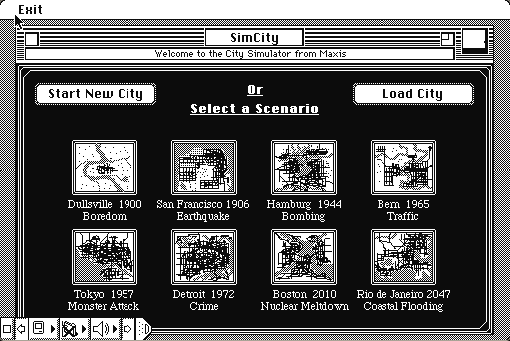
This is that original, on the Macintosh, in black and white. No 3D, no tutorial, no advisors — a grid, three zone types, and a budget you will get wrong.
Boots straight into SimCity on a Macintosh SE — a 512×342 black-and-white screen, which is the machine this build was written for. Start a new city, lay a road, put down a power plant, then zone.
Controls
| Mouse | Everything — select a tool, then click or drag on the map |
| Tool palette | Residential, commercial and industrial zones, roads, power, services |
| Cmd-S | Save your city |
| Cmd-Q | Quit to the Finder |
The 1989 Macintosh release has not been sold by anyone for over thirty years. Maxis was bought by Electronic Arts in 1997, and in 2008 EA released the SimCity Classic engine as open source under the GPL, renamed Micropolis because the trademark was retained. The code lineage is free; the brand is not; this particular artefact is long out of commerce. Full reasoning is in notices/simcity.md, and the takedown promise applies without argument.
Source and archives
- Micropolis — the original SimCity engine, released by EA under the GPL in 2008.
- Internet Archive — the preserved Macintosh floppy this copy came from.
How it works & what to expect
| Machine | Macintosh SE, 512×342 black and white |
|---|---|
| System | System 7.5.3 |
| Emulator | Mini vMac, compiled to WebAssembly |
| Version | 1.2, the black-and-white Macintosh release |
| Saves | Inside the emulated Mac, which lives in your browser. Do not keep anything irreplaceable there. |
The screen is small because the machine was. This is the black-and-white build, written for the compact Macs, and it will not start on a colour screen — which is why it runs here on an emulated SE rather than the Macintosh II the colour titles use.
This is the original, so a lot of what modern players expect is absent. There are no advisors telling you what is wrong, no tutorial, and no undo. The manual did the teaching, and the game assumed you would read it.
The whole game, in three zones
You paint three kinds of zone — residential, commercial, industrial — connect them with roads and power, and then watch what happens. Nothing grows unless it has power and a road. Industry pollutes and residents move away from pollution. Commerce needs residents to shop and workers to staff it. Raise taxes and growth slows; lower them and you cannot pay for the fire service, which matters more than it sounds.
That is the entire model, and it is enough to produce a city that surprises you. The famous part is that there is no win condition. You are not beating anything. You are running a place, and the only judgement is whether it works.
There are also disasters — fires, floods, tornadoes, and a monster — which exist mostly so that the simulation has something to recover from.
Why it took four years to publish
Wright built the city editor for Raid on Bungeling Bay, a 1984 Commodore 64 shooter, and found that laying out the cities was more interesting than bombing them. The game that resulted had no score, no opponent and no ending, and every publisher he showed it to explained that this was not a game.
Jeff Braun disagreed, and the two of them founded Maxis to publish it. SimCity came out in 1989 for the Macintosh and the Amiga, sold slowly, won awards, and then sold for a decade. It produced SimEarth, SimAnt, SimTower, The Sims — which became the best-selling PC game series ever made — and an entire category of software about running a system rather than defeating one.
In 2008 EA released the original engine as open source under the GPL, renamed Micropolis, for the One Laptop Per Child project. The code behind this game is free software; the name is not.
Questions people ask
Is this the real original SimCity?
Yes — version 1.2 of the 1989 Macintosh release, in black and white, running as it shipped. Not SimCity Classic for Windows, not the 1993 SNES version, and not any of the remakes.
Why is it black and white?
The Macintosh original was. Colour Macs existed by 1989 but the game targeted the compact machines most people owned, and the whole visual design is built from dither patterns.
Why a Macintosh SE and not something faster?
Because this build will not run on anything else. It is the black-and-white release, and it refuses to start on a colour screen — it opens, finds a colour monitor, and quits. The SE gives it the 512×342 one-bit display it was written for.
How do I start?
Begin a new city, choose a terrain, then lay a road, place a power plant, and zone a small residential area near it. Nothing grows without both power and road access, which is the first thing everyone gets wrong.
There is no tutorial. Is that right?
That is right. The game shipped with a printed manual that did the teaching, and it assumes you will experiment. Keep the first city small and watch what the budget does.
Is EA going to mind?
Possibly, which is why the reasoning is written down in full and the takedown promise is unconditional. The 1989 Macintosh release has not been sold by anyone in over thirty years, and EA released the original engine as open source in 2008 under the name Micropolis.
Can I keep my city?
Saves live inside the emulated Mac, in your own browser. They survive closing the tab but not clearing site data, and they do not follow you to another device.