After Dark and the Flying Toasters, running for real Runs here
1991 · Berkeley Systems · System 7 · Mini vMac (Mac II) · 640×480 at 8-bit colour
Guide updated September 2026
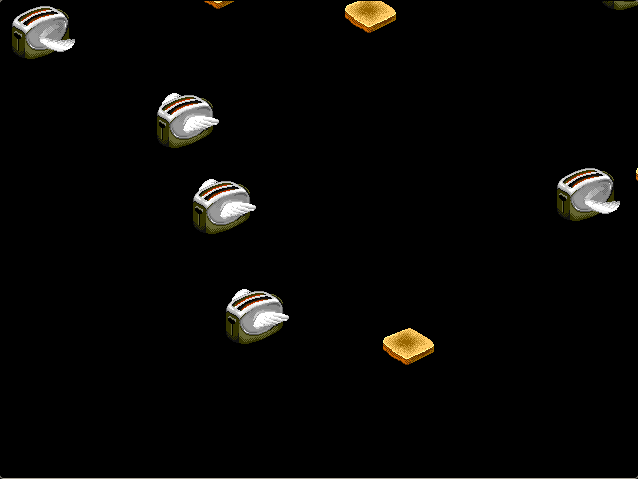
In 1989 Berkeley Systems shipped a utility that stopped your monitor from burning an image into its phosphor. In 1991 they added a module in which chrome toasters with flapping wings fly slowly across the screen accompanied by slices of toast, and that module became one of the most recognisable pieces of software of the decade.
There are dozens of Flying Toasters tributes on the web built out of CSS and JavaScript. This is not one of them. It is the actual software, on an emulated Macintosh running System 7.5.3, with the control panel, the sliders, and all seventy-one modules Berkeley Systems shipped.
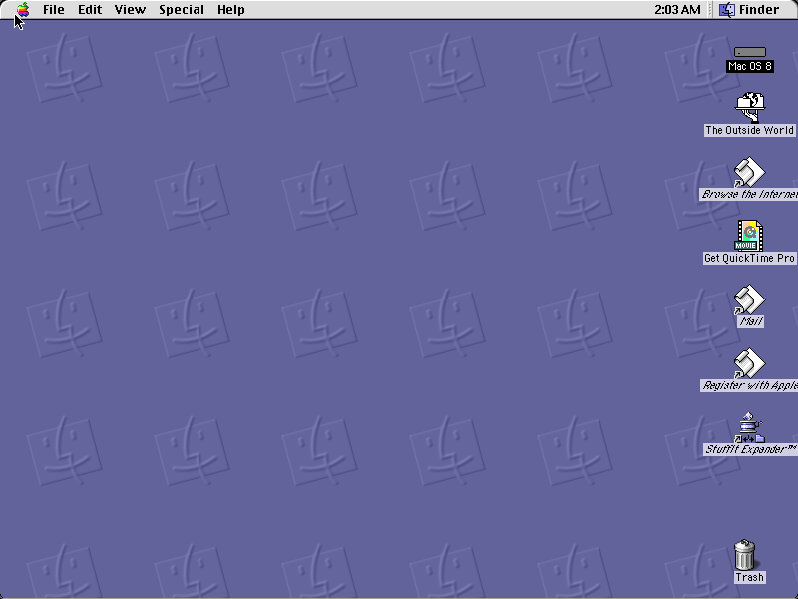
Boots to the desktop with After Dark already installed. Leave it alone for a minute and the screensaver starts by itself — or open the After Dark control panel (Apple menu › Control Panels) and press Demo to skip the wait.
Controls
| Wait a minute | After Dark starts on its own, exactly as it did |
| Apple › Control Panels › After Dark | Pick a module and change its settings |
| Demo button | Run the selected module immediately |
| Any key or mouse move | Stop the screensaver, as it always did |
Berkeley Systems was absorbed in the late 1990s and After Dark has not been sold for a very long time; the trademark has drifted between owners and nobody distributes the Macintosh version. There are dozens of Flying Toasters tributes on the web made of CSS and JavaScript. This is not one of them — it is the actual software, running on an actual emulated Macintosh.
Get a copy
- Macintosh Garden carries the Macintosh releases and the expansion module sets.
How it works & what to expect
| Machine | Macintosh II, 640×480 in colour |
|---|---|
| System | System 7.5.3, with After Dark 2.0 installed |
| Emulator | Mini vMac, compiled to WebAssembly |
| Modules | All 71, including Flying Toasters, Fish!, Boris, Mowin' Man and Lunatic Fringe |
| Sound | Yes, and several modules are mostly about the sound. Click inside the screen once to let the browser play audio. |
After Dark was not an application — it was a system extension and a control panel, which is why it needs a whole Macintosh around it rather than being something you could port to a web page. That is also why running it means booting System 7 first.
It behaves exactly as it did on a real machine: leave the Mac idle for about a minute and the screensaver takes over. If you would rather not wait, open the control panel from the Apple menu and press Demo.
The modules worth your time
- Flying Toasters. The famous one. Chrome toasters, flapping wings, slices of toast, and a slider for how many.
- Fish! An aquarium. Berkeley Systems' first hit module and, for a lot of offices, the reason After Dark got bought.
- Mowin' Man. A small man mows your screen. When he finishes, it grows back.
- Warp. Stars streaking past. Simple, and the one that looked best on a big monitor.
- Boris. A cat that walks across your screen, and later got a whole product to himself.
- Rainstorm. Rain down the glass with thunder. Genuinely calming, thirty-five years on.
There is also a Randomizer, which cycles modules, and a MultiModule that runs several at once — which on a 1991 Macintosh was showing off.
Why a screensaver mattered
The original justification was technical and real. Cathode-ray tubes with a static image left on them for weeks would retain a ghost of it permanently, and in an office full of terminals showing the same spreadsheet all day, that was a genuine hardware problem.
What Berkeley Systems worked out is that the fix could be entertainment. A screensaver is a piece of software with no job to do and complete freedom over the screen, running in an era when almost every other program was a grid of grey boxes. After Dark was one of the first pieces of software people bought for pleasure rather than for a task, and the toasters ended up on t-shirts, mugs and a lawsuit with Jefferson Airplane over whose flying toasters came first.
LCD panels do not burn in the way CRTs did, so the technical reason evaporated. The toasters outlived it comfortably.
Questions people ask
How do I make the toasters appear?
Either wait or skip the wait. Left alone for about a minute the emulated Mac goes idle and After Dark starts on its own, which is what it did on a real machine. To choose a module yourself, open Apple menu › Control Panels › After Dark, pick one from the list on the left, and press Demo.
Is this the real After Dark or a web imitation?
The real software. There are many Flying Toasters tributes built in CSS, JavaScript or as modern screensavers; this is Berkeley Systems' actual Macintosh release running inside an emulated Macintosh, control panel and all.
Which version is this?
The Macintosh After Dark from the early 1990s, the version whose module set includes Flying Toasters, Fish!, Mowin' Man, Warp and Boris.
Why does it need a whole emulated Macintosh?
Because After Dark was a system extension, not an application. It hooked into the Mac OS to take over the screen when the machine went idle, which means it only exists in the context of a running Mac OS.
Who owns After Dark now?
It is genuinely murky. Berkeley Systems was acquired in the late 1990s and the After Dark name has changed hands more than once since, but nobody has sold the Macintosh version in decades. If you hold the rights, the takedown page is linked in the footer.
Were the Flying Toasters stolen from Jefferson Airplane?
Jefferson Airplane sued over it in 1994, pointing at the cover of their 1973 album Thirty Seconds Over Winterland, which has flying toasters on it. The case did not go the band's way.
Can I use it as my actual screensaver?
No — it runs inside the emulated Mac, in a browser tab, so it has no way to take over your real screen. What you get is the thing itself, on demand.