Prince of Persia — sixty minutes Runs here
1992 · Broderbund · System 7 · Mini vMac (Mac II) · 640×480 at 8-bit colour
Guide updated September 2026
You wake in a dungeon. The princess is in a tower. The vizier Jaffar has given her an hour to marry him or die, and the clock is the real one — sixty minutes of wall time for the entire game, and it keeps running while you fall on spikes.
This is the Macintosh version, in colour, and it moves like nothing else from its era because the animation was traced frame by frame from film of a real person.
Boots straight to the title screen on an emulated Macintosh II. Press a key to start. The clock begins when you do.
Controls
| Arrow keys | Walk, turn, climb up, crouch |
| Shift | Walk carefully — essential near edges and spikes |
| Shift + arrow | Grab a ledge, or pick something up |
| Up arrow while running | Running jump, which is how you cross the wide gaps |
| Cmd-Q | Quit to the Finder |
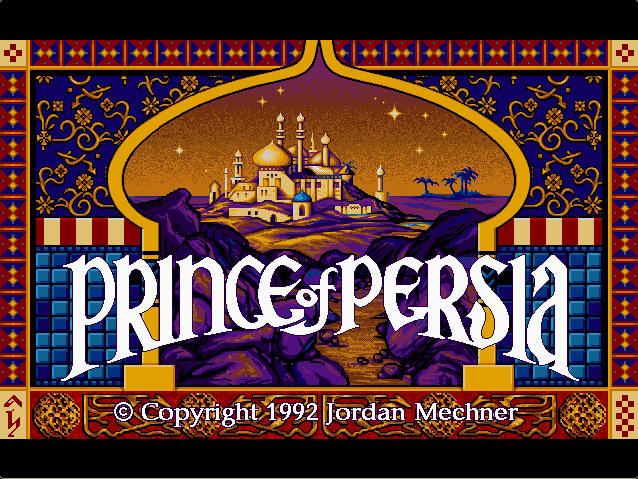
Jordan Mechner created Prince of Persia and Broderbund published it; Ubisoft has owned the property since 2001 and actively sells games under the name. Those are new software. Mechner released the original Apple II source code himself in 2012. The 1992 Macintosh port has not been sold in over thirty years. This is a live rights holder, so the reasoning is set out carefully in notices/prince-of-persia.md, and the takedown promise applies without argument.
Source and archives
- The original source — Jordan Mechner published the Apple II source code in 2012.
- Internet Archive — the preserved Macintosh disk this copy came from.
How it works & what to expect
| Machine | Macintosh II, 640×480 colour |
|---|---|
| System | System 7.5.3 |
| Emulator | Mini vMac, compiled to WebAssembly |
| Version | The 1992 Macintosh release |
| Saves | Inside the emulated Mac, in your browser. |
The controls take a few minutes because the prince has weight. He does not stop when you release the key — he skids, and he falls off ledges you thought you had cleared. Holding Shift makes him move carefully, and learning when to use it is most of the game.
The sixty-minute limit runs across the whole game, not per level, and it persists through deaths. Dying restarts the level but not the clock, which is why the game is really about learning routes rather than surviving them.
Why the animation looks like that
Mechner filmed his younger brother David running, jumping and climbing in a car park, then traced the footage frame by frame — a technique borrowed from animation called rotoscoping, and almost unheard of in games in 1989.
The result is a character who moves with real momentum: he leans into a run, catches himself on a ledge with his feet swinging, and staggers when he lands badly. Every platform game since has been compared to it, and games as recent as the Ori and Celeste lineage are working in a tradition this started.
It also cost enormously in memory — each frame of that animation had to be stored — which is why the levels are so spare. The trade was deliberate: fewer things on screen, and the one thing that is there moves like a person.
Getting further than the first ten minutes
Hold Shift near edges. Walking carefully stops you skidding off, and the majority of early deaths are skids.
Take a run-up for wide gaps. A standing jump clears very little. Back up, run, and press up as you reach the edge.
The guards are a rhythm, not a race. Parry, strike, step back. Attacking wildly loses every time.
Drink the small potions, avoid the ones that look wrong. Red restores health, blue is usually poison, and the tall ones raise your maximum.
The clock does not stop. Sixty minutes for the whole game. If you are exploring carefully you are losing, which is a genuinely unusual thing for a game of this age to demand.
Questions people ask
Is this the original Prince of Persia?
It is the 1992 Macintosh port of it, in colour. The Apple II original from 1989 came first and looks rather different; this is the version Mac owners played.
Is the sixty-minute limit real?
Completely. It covers the whole game, it keeps running while you are dead, and it is the reason the game is about learning routes rather than exploring them.
Why is it so hard to control?
The prince has momentum, deliberately. Hold Shift to move carefully, and take a run-up before any jump that looks long.
How do I fight?
It is a rhythm. Parry with back, strike with forward, and wait for the opening rather than pressing constantly.
Why does the animation look so smooth?
Because it was rotoscoped — Jordan Mechner filmed his brother running and jumping, then traced the footage frame by frame.
Can I save?
The game saves to the emulated Mac's disk, which lives in your browser. It survives closing the tab but not clearing site data.