Reader Rabbit — the original four games Runs here
1987 · The Learning Company · System 6 · Mini vMac (Mac SE) · 512×342 black and white
Guide updated September 2026
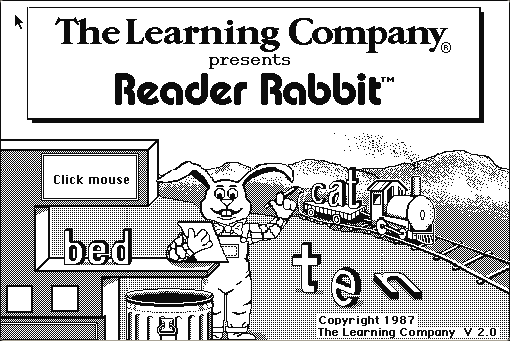
A rabbit in dungarees, a word factory, and a train pulling three-letter words across the screen. Reader Rabbit taught a very large number of people to read, and it did it with four small games and no story at all.
This is the Macintosh version — black and white, and it talks, which in 1987 was the part that made people stop and look.
Boots straight into Reader Rabbit on an emulated Macintosh SE. Click the mouse at the title screen to begin, then pick one of the four games.
Controls
| Mouse | Everything — click to choose a game, click to pick a letter or word |
| Return | Confirm |
| Cmd-Q | Quit to the Finder |
The Learning Company passed through SoftKey, Mattel, Gores Technology and Houghton Mifflin Harcourt, and Reader Rabbit products have been published under the name since. Those are new software. This Macintosh build has not been sold in over thirty years. Full reasoning is in notices/reader-rabbit.md, and the takedown promise applies without argument.
Archives
- Internet Archive — the preserved Macintosh floppy this copy came from.
- Macintosh Garden — other releases and documentation.
How it works & what to expect
| Machine | Macintosh SE, 512×342 black and white |
|---|---|
| System | System 7.5.3 |
| Emulator | Mini vMac, compiled to WebAssembly |
| Version | 2.0, the Macintosh release |
| Speech | MacinTalk, Apple's 1984 speech synthesiser |
| Saves | Inside the emulated Mac, in your browser. |
The disk this came from carried MacinTalk beside the application — Apple's speech synthesiser, released in 1984 and quietly one of the reasons the Macintosh felt like the future. Reader Rabbit uses it to say the words aloud, and it has been installed into the System Folder here so that it does.
It does not sound good. It sounded extraordinary at the time.
The four games
Sorter puts words on a conveyor and asks the child to sort them by a shared letter, which is the quiet foundation the other three stand on.
Labeller shows an object and a set of words, and the child picks the one that names it.
Word Train is the one everybody remembers: carriages rolling past carrying three-letter words, each of which has to differ from the last by exactly one letter. cat, cot, cog, dog. It is a word ladder, and it is a genuinely elegant piece of teaching disguised as a train.
Matchup is a memory game played with words and pictures.
All four use the same pool of two hundred or so three-letter words, so a child who has played one is not starting cold in the next.
Why this one mattered
The Learning Company was founded in 1980 by Ann McCormick, Leslie Grimm, Teri Perl and Warren Robinett — Robinett being the Atari programmer who had hidden his own name inside Adventure and invented the video game easter egg in the process.
Their argument was that educational software should be built by people who understood how children actually learn, not by programmers adding a quiz to a game. Grimm, who wrote Reader Rabbit, had a doctorate and had taught reading.
It shows. The four games are not four themes on one drill; they attack the same skill from four directions, and the one everyone remembers — the train — is the one that teaches the most. Reader Rabbit sold for twenty years and became the name an entire category was measured against.
Questions people ask
Is this the original Reader Rabbit?
It is the Macintosh release of the original, version 2.0, in black and white with all four games. Not the later CD-ROM Reader Rabbit titles, which are much bigger and quite different.
Does it really talk?
Yes, through MacinTalk, Apple's 1984 speech synthesiser, which shipped on the same disk and is installed here. It sounds like 1984, because it is.
What age is it for?
Roughly four to seven — children who know their letters and are starting to put them together into words.
Which game should we start with?
Word Train. It is the most fun, and the one-letter-at-a-time word ladder is the idea the whole program is built around.
Why is it black and white?
The Macintosh it was written for was. The artwork is drawn in one-bit patterns and is surprisingly expressive for it.
Is progress saved?
Inside the emulated Mac, in your own browser. It survives closing the tab but not clearing site data.