Speller Bee — the Macintosh reads the word out loud Runs here
1986 · First Byte · System 6 · Mini vMac (Mac Plus) · 512×342 black and white
Guide updated September 2026
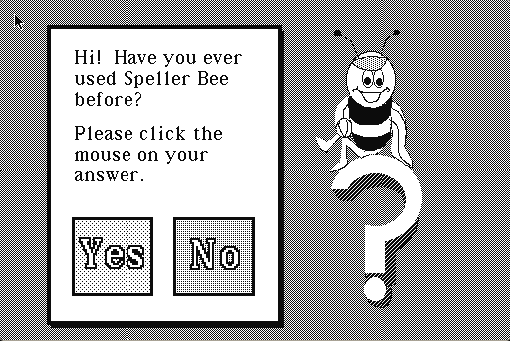
A cartoon bee leans on a question mark and asks whether you have used Speller Bee before, with Yes and No buttons. Answer and it gets going: it reads a word aloud and you spell it.
The speech is the reason this existed. First Byte sold a synthesiser called SmoothTalker and built a line of talking educational software around it, at a time when a computer that spoke was remarkable enough to be the entire product.
Boots straight into Speller Bee, which asks whether you have used it before. Turn your sound on first.
Controls
| Mouse | Answer the prompts and work the menus |
| Keyboard | Type the word you heard |
| Menus | Word lists, difficulty and voice settings |
First Byte was a speech-technology company that no longer exists. Speller Bee has not been sold in decades and no successor product contains it.
Archives
- Internet Archive — the Macintosh floppy this copy was made from.
How it works & what to expect
| Machine | Macintosh Plus, 512×342, black and white |
|---|---|
| System | The floppy's own — this disk carries the System it shipped with |
| Emulator | Mini vMac, compiled to WebAssembly |
| Saves | Word lists and progress persist inside the emulated Mac |
Turn your sound on. The speech is the entire premise; without it this is a typing exercise with no prompt.
The voice is 1986 formant synthesis on an 8 MHz machine: intelligible and strange. That is not an artefact of emulation — it sounded exactly like this at the time, and deciphering it is arguably part of the exercise.
Why it is remembered
Talking software was a genre. First Byte built SmoothTalker and then wrapped it in a line of children's programs — Speller Bee, MathTalk, KidTalk — sold on the proposition that the computer would speak. For a few years that was enough to build a company on.
Accessibility ran underneath it. Synthesised speech on a personal computer in 1986 mattered enormously to people who could not read a screen, and the same technology that made a spelling program possible was quietly doing more important work elsewhere.
Its sibling did not survive. SmoothTalker itself is in the same archive and still demands its original disk on startup, so it cannot be hosted. Speller Bee is the one of the pair that runs.
Getting started
Turn the volume up before you answer the first question.
Answer "No" the first time. The explanation is short and written for children who have never seen it.
If a word is unclear, have it repeated before guessing. The synthesiser's vowels are the hard part and a second listen usually settles it.
Questions people ask
Do I need sound?
Yes. The program reads words aloud and that is the whole point of it.
Why does the voice sound like that?
It is 1986 formant speech synthesis on an 8 MHz Macintosh. It sounded exactly like this at the time.
Is it for children?
Yes, it is a spelling program for young readers, and it asks at the start whether you have used it before.
Can I add my own word lists?
The program supports editable lists, and they persist inside the emulated Macintosh.
Is SmoothTalker here too?
No. The surviving copy still demands its original disk on startup, so there is nothing playable to host.
Who made it?
First Byte, which built the SmoothTalker synthesiser and a line of talking software around it.
Put Speller Bee on your own site
Free, no permission needed and no account. Paste this where you want the machine to appear; it brings its own emulator and asks nothing of your page.
<iframe src="https://macemu.com/embed/speller-bee/"
        width="512" height="342"
        style="border:0;max-width:100%"
        allowfullscreen
        title="Speller Bee"></iframe>
Sized to this title's real screen. How embedding works.