Seastalker — the Aquadome is under attack and it is your submarine Runs here
1984 · Infocom · System 6 · Mini vMac (Mac Plus) · 512×342 black and white
Guide updated September 2026
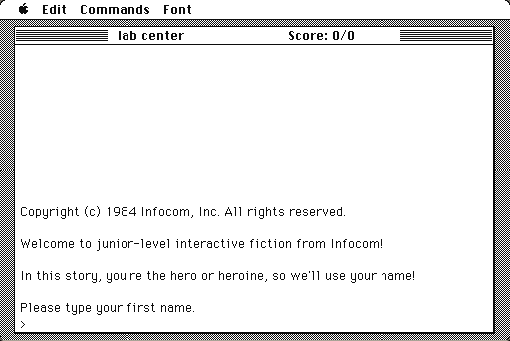
You are a teenage inventor, the undersea research station you built is being attacked by something large, and the submarine that can get you there is the one you designed. Seastalker asks your name at the start and then uses it, which was a small trick and is still an effective one.
Infocom labelled it "junior level", meaning it was written for younger or newer players: the puzzles are fairer, the prose is plainer, and it is much harder to make the game unwinnable. It is also the only Infocom game with a genuine sidekick who talks to you throughout.
Boots straight into the game and asks for your first name. Type it and the story starts.
Controls
| Type + Return | Everything. This is a parser game. |
| LOOK / INVENTORY | Describe the room; list what you carry |
| ASK <person> ABOUT <thing> | Your crew will tell you things |
| SAVE / RESTORE | Save inside the emulated Mac |
Activision owns Infocom's catalogue and still exists. Seastalker has not been sold since Classic Text Adventure Masterpieces went out of print in the late 1990s and is part of no current product.
Archives
- Internet Archive — the Macintosh floppy this copy was made from.
How it works & what to expect
| Machine | Macintosh Plus, 512×342, black and white |
|---|---|
| System | The floppy's own — this disk carries the System it shipped with |
| Emulator | Mini vMac, compiled to WebAssembly |
| Release | 15 |
| Saves | SAVE writes inside the emulated Mac, in your browser |
Seastalker shipped with a sonar chart and a set of "InfoCards" that the game refers to by number during the submarine sequences. Those were printed and are not on the disk; the relevant sections can be got through by careful reading, but scans are worth having.
It is short by Infocom standards and the most forgiving thing they published. If you have bounced off interactive fiction before, this and Wishbringer are the two to try.
Why it is remembered
It used your name. The game asks at the start and characters address you by it throughout. Trivial to implement, surprisingly effective, and almost nothing else was doing it in 1984.
It was the deliberate on-ramp. Infocom's reputation for difficulty was a commercial problem, and Seastalker was the answer: a real game with the cruelty removed. The idea worked well enough that Wishbringer followed a year later.
The submarine sequences are genuinely tense. Navigating by sonar while something circles you is the best thing in the game, and it holds up.
Getting started
Answer honestly when it asks your name — the game will use it and it is more fun that way.
Talk to everyone. Your crew know things and will tell you if you ask, which is unusual for Infocom and is how the game intends to be played.
Take notes during the sonar sections. The bearings matter and the game expects you to have written them down rather than remembered them.
Questions people ask
Is this a children's game?
It is Infocom's "junior level", which means fairer puzzles and plainer prose rather than a lesser game. Adults new to interactive fiction are the other audience it suits.
Are the InfoCards included?
No. They were printed cards the game refers to by number. Scans circulate and are useful for the submarine sections.
Does it really use my name?
Yes. It asks at the start and characters use it throughout.
Can it become unwinnable?
Much less easily than most Infocom games — that was the point of the junior level.
Can I save?
Yes. Type SAVE. Saves live inside the emulated Macintosh in your browser.
Who wrote it?
Stu Galley and Jim Lawrence; Galley also wrote The Witness.
Put Seastalker on your own site
Free, no permission needed and no account. Paste this where you want the machine to appear; it brings its own emulator and asks nothing of your page.
<iframe src="https://macemu.com/embed/seastalker/"
        width="512" height="342"
        style="border:0;max-width:100%"
        allowfullscreen
        title="Seastalker"></iframe>
Sized to this title's real screen. How embedding works.