Legends of the Lost Realm — Avalon Hill does a dungeon crawl Runs here
1988 · Ronald Coleman / Avalon Hill · System 7 · Mini vMac (Mac SE) · 512×342 black and white
Guide updated September 2026
Avalon Hill spent decades making hex-and-counter wargames on cardboard, and in 1988 it published a party-based Macintosh role-playing game. Legends of the Lost Realm has the seriousness you would expect from that pedigree: dense systems, an unhurried pace, and no interest at all in making the first hour easy.
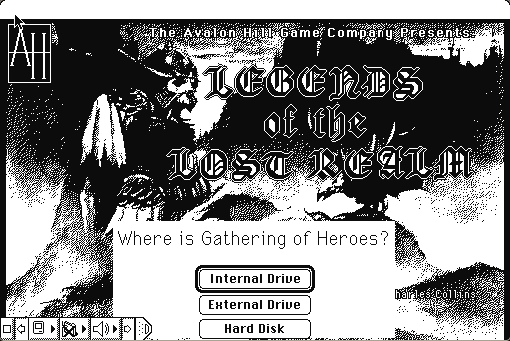
On startup it asks which drive holds the "Gathering of Heroes" scenario data. It is on this disk — choose the hard disk and it will find it.
Boots to the Avalon Hill title, then asks where the scenario data is. Choose Hard Disk.
Controls
| Mouse | Menus, party management and most interaction |
| Keyboard | Movement through the world |
| Menus | Party, inventory, combat and saving |
Avalon Hill's game division was bought by Hasbro in 1998 and the Avalon Hill name is in current use for boardgames. The computer-game catalogue has not been published since and no Hasbro product contains this Macintosh program.
Archives
- Internet Archive — the Macintosh floppy this copy was made from.
How it works & what to expect
| Machine | Macintosh SE, 512×342, black and white |
|---|---|
| System | System 7.5.3 — see the note below |
| Emulator | Mini vMac, compiled to WebAssembly |
| Version | 2.0 |
| Saves | Parties save inside the emulated Mac, in your browser |
The drive question on startup is expected. The game was written to load its scenario from a second floppy and asks where to look. Everything it needs is on this one disk; pick Hard Disk and continue.
The floppy's own System would not start the game on an emulated Macintosh Plus, so the application and its data were copied onto a System 7.5.3 boot disk. That is why a desktop appears briefly first.
Why it is remembered
It is Avalon Hill on a Macintosh. The company that published Squad Leader and Diplomacy had a computer division that is now almost entirely forgotten, and its output has largely not been preserved. This is one of the surviving pieces.
Scenario disks were the plan. "Legends of the Lost Realm I" is numbered because Avalon Hill intended a series driven by add-on scenarios, in the Wizardry mould. A second was published; the line did not go much further.
It is unusually systems-heavy. Even by 1988 dungeon-crawl standards the rules are dense, which is exactly what you would expect from a boardgame publisher's idea of a role-playing game.
Getting started
Answer the drive question with Hard Disk. Nothing else will work and it is the first thing the game asks.
Build a full party and read the class descriptions properly. The system is detailed enough that a badly composed party is a real handicap rather than a stylistic choice.
Save early and often, and expect the first expedition to go badly. This is a 1988 dungeon crawl by a wargame publisher; it assumes patience.
Questions people ask
Why does it ask about drives on startup?
It was written to load its scenario from a second floppy. Everything is on this one disk — choose Hard Disk.
Is this the whole game?
Yes, The Gathering of Heroes, version 2.0. A second Legends title was published separately and is not here.
Can I save?
Yes — parties save inside the emulated Macintosh in your browser.
Why does a desktop appear first?
Its own floppy would not boot the game on an emulated Mac Plus, so it runs from a System 7.5.3 disk.
Who made it?
Ronald Coleman, published by The Avalon Hill Game Company in 1988.
Is it hard?
Yes, and dense. It is a wargame publisher's take on a dungeon crawl and it expects patience.
Put Legends of the Lost Realm I: The Gathering of Heroes on your own site
Free, no permission needed and no account. Paste this where you want the machine to appear; it brings its own emulator and asks nothing of your page.
<iframe src="https://macemu.com/embed/legends-lost-realm/"
        width="512" height="342"
        style="border:0;max-width:100%"
        allowfullscreen
        title="Legends of the Lost Realm I: The Gathering of Heroes"></iframe>
Sized to this title's real screen. How embedding works.