Classic Mac role-playing games
The Macintosh was never the role-playing machine. The big series of the 1980s were written for the Apple II and the PC first, and some never came to the Mac at all. What did arrive, though, was often better suited to a mouse than the original, and the Mac grew a small, stubborn RPG culture of its own that peaked in the shareware years of the 1990s. Everything on this page runs in your browser.
Where the genre comes from
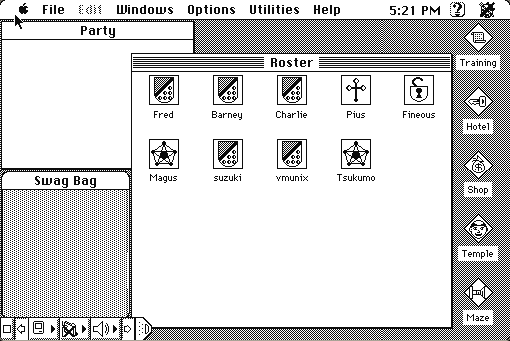
Wizardry: Proving Grounds of the Mad Overlord is the source of the party-based dungeon crawl. Six characters, a marching order, a ten-level maze drawn in wireframe from the front of the party, and no automap. When a party dies down there the bodies stay until another party goes to fetch them. The Macintosh version replaced the Apple II's keyboard menus with windows and a mouse, and is one of the better ways to play the original. Wizardry II: The Knight of Diamonds was the first scenario disk anyone made for a computer RPG, and assumes you are bringing a party that has already finished the first game.
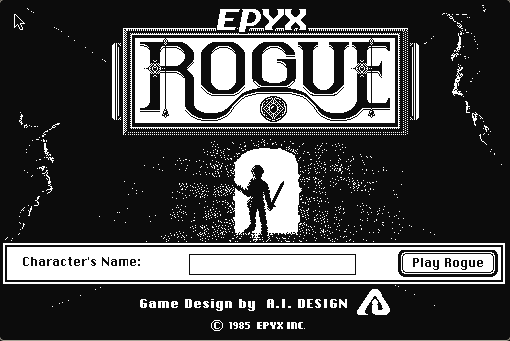
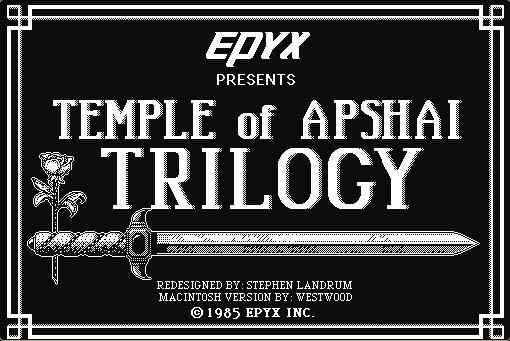
Rogue is the other root, and the one whose name became a genre. A dungeon generated anew every game, a single character, and death that is final. The version here is the 1985 Macintosh release, where A.I. Design threw away the letters and drew everything. Temple of Apshai Trilogy is older still in origin — the first Apshai, from 1979, is one of the earliest commercial computer RPGs — and this 1985 Macintosh rebuild gathers it and both sequels onto one disk.
Written for the Macintosh
A few RPGs of the 1980s were built for the Mac rather than ported to it, and you can tell. OrbQuest opens on an illuminated scroll and uses the Mac's windows the way the Mac's own software did. Legends of the Lost Realm came from Avalon Hill, the board wargame publisher, and plays with the density and the patience you would expect from that background. Neither is gentle for the first hour, and both repay the effort.
The shareware years
By the mid-1990s the most interesting Macintosh RPGs were being made by individuals and sold on the honour system. Realmz is the landmark: a turn-based party RPG in the Wizardry line, with a deep rule set and, more importantly, an engine that separated the game from its adventures, so that players wrote and swapped scenarios of their own for years. Cythera, published by Ambrosia, went the other way — an open island full of people with their own business, a plot you can miss entirely, and a world that does not organise itself around you. It is the one Mac RPG people still argue about.
Both are the unregistered shareware releases, distributed exactly as their authors distributed them. The registration notices are part of the software and are left in place, which is also what their licences ask for. See the shareware page for why that matters here.
Playing them now
These are long games. The good news is that titles here keep their disks between visits where they can, so a party rolled today is still there tomorrow — close the tab, come back, and the machine is where you left it. Save inside the game as well, because an emulated Macintosh is still a Macintosh and nothing stops a dungeon from killing everyone.
Expect to read. None of these games explain themselves the way modern ones do, and most assumed you had a manual open beside the keyboard. The individual pages carry the controls and the first steps; the rest is mapping on paper, which is still how these are best played.
Play now
-
 Cythera NEW▶ Play free
-
 Rogue NEW▶ Play free
-
 Wizardry: Proving Grounds of the Mad Overlord NEW▶ Play free
-
 Temple of Apshai Trilogy NEW▶ Play free
-
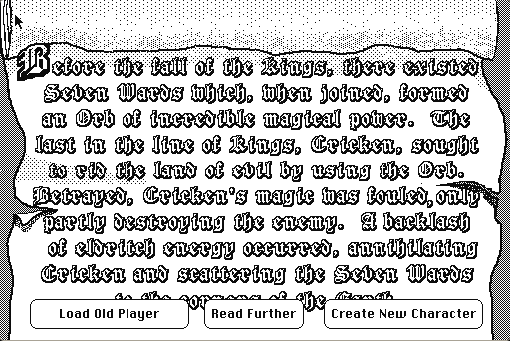 OrbQuest NEW▶ Play free
-
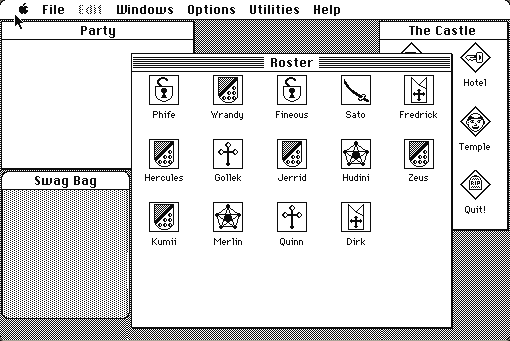 Wizardry II: The Knight of Diamonds NEW▶ Play free
-
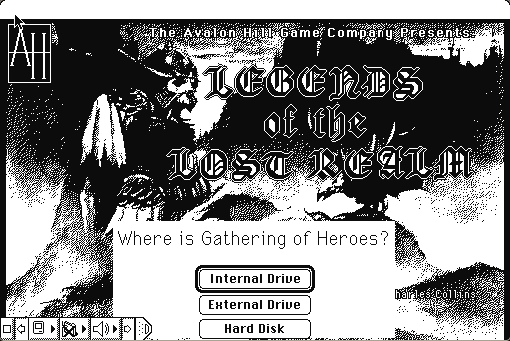 Legends of the Lost Realm I: The Gathering of Heroes NEW▶ Play free
-
 Realmz NEW▶ Play free